
Walk Villa Park Streets by Address
A Villa Park street directory works best as a sequence of official checks, not as one list of names. The DuPage property card identifies the parcel and its billing owner. The county map then shows the lot, nearby parcels, municipality, and district lines. Recorded deeds supply transaction parties, while a voter match or a dated directory may add evidence that a person used the address. None of these sources, alone, proves who is inside a home today.
- Enter the number and road name in the DuPage Property Records Search. Save the returned property address, PIN, legal description, and billing name.
- Open the same parcel in the DuPage Parcel Viewer. Pan along the road and check each parcel rather than treating a ZIP label as the village line.
- Use a known name, birth date, ZIP, and street in the state voter match. It confirms a supplied match; it does not reveal a street roster.
- Move the PIN or owner name to the Recorder index. Compare deeds, plats, and other recorded items with the parcel card.
- For an older household, ask the library or museum about dated telephone books and directories, then verify the date in newspapers or census records.
Keep the source date beside every result. A parcel card can change after a sale, and a historic directory is only a snapshot. The street-by-street process is strongest when the PIN, legal description, and exact situs address agree across the county systems.
Search Villa Park Property Fields
The DuPage address search is the practical first stop for a known house number. Its modes separate an address from a PIN and from a billing name. That distinction matters. A billing name is the name used for tax mail, while the situs or property address describes the parcel itself. Neither is a full list of residents.
| Field | Input | Use on a Street Search |
|---|---|---|
| Property Address | Number and street components | Find the parcel and preserve the returned spelling |
| PIN | County parcel identifier | Carry one parcel into GIS and Recorder searches |
| Billing Name | Person or organization | Compare the tax-mail name with the property fields |
| Map | Spatial selection | Find corner lots or uncertain road spellings |
| Property Tax Bill | Result action | Review the bill route; a popup blocker may hide it |
The county says the public data reflects the last certified assessment. A property card can also expose value history, transfers, exemptions, appeals, split or combine clues, and a legal description. Treat an exemption as a tax classification for a stated period, not proof of every occupant. For help, the Supervisor of Assessments counter at 421 N. County Farm Road in Wheaton generally serves the public on weekdays, and its main number is 630-407-6500.
Map a Villa Park Street Segment
The DuPage Parcel Viewer turns one search result into a street view of parcel boundaries. Search by property address or basic PIN, select the result, and use the map layers or historic imagery to study the block. The Street Intersection tool accepts two street-name fields. Measure tools cover distance, area, and location, while the subdivision control can display a named plat area.
For a set of parcels, the county guide documents a 250-foot default buffer. Selected records can be exported as TXT, CSV, PDF, XLS, or XLSX, with a documented selection cap of 1,000. A buffer is a research radius, not a legal neighborhood boundary. Compare each result's municipality with its property city and billing city before calling it part of Villa Park.
Villa Park address quirk. A parcel may display VILLA PARK as the property city while the GIS municipality says Uninc. and tax mail goes to another city.
That three-address test prevents a common error. The postal label helps deliver mail. The municipality field and parcel geometry answer the jurisdiction question. The billing address only shows where the county sends tax correspondence.
Villa Park Street Records Compared
Each official source answers a different question about a Villa Park address. The street directory chain becomes reliable only when the parcel number links the map, tax card, and recorded-document search. Names in voter or historical sources add context, but they do not turn the property roll into a household roll.
| Record Set | Keeper | What It Shows | Access |
|---|---|---|---|
| Assessment card | DuPage Property Records | PIN, billing name, situs, values, transfer clues | Free web modes and county counter |
| Parcel map | DuPage GIS | Lot shape, nearby parcels, municipality, districts | Free viewer and ArcGIS layer |
| Recorded documents | DuPage Recorder | Deeds, plats, liens, easements, transaction parties | Online index; desk for older work |
| Voter match | State Board and County Election Division | Registration match for supplied identity and address data | Match-only portal; controlled file route |
| Permits and code files | Villa Park Community Development | Project address, type, status, releasable application fields | Portal, department, or narrow FOIA request |
Do not merge rows merely because the street names look alike. Save the exact address, direction, apartment notation, property city, municipality, and source date. Then use the PIN as the stable link. If a portal returns nothing, record whether the cause may be an address cutoff, a parcel split, a protected voter entry, or a record that has not been indexed online.
Move Villa Park PINs to Deeds
The DuPage Recorder search accepts party names, subdivision or business names, street components, a four-part PIN, document number, document type, and date range. Its roles include grantor and grantee. A grantor gives an interest; a grantee receives one. Use both roles and a narrow period so a common surname does not swallow the useful result.
The online index and images begin March 16, 1961. Official instructions give different computer-search cutoffs: name from 1961, PIN from 1985, and address from 1995. County property records themselves reach back to 1839, and plats can reach the 1800s. An empty address search before 1995 is therefore a portal limit, not proof that no deed exists.
The successful manifest capture comes from the same official Recorder form: open the live deed-index search before using the fields shown below.
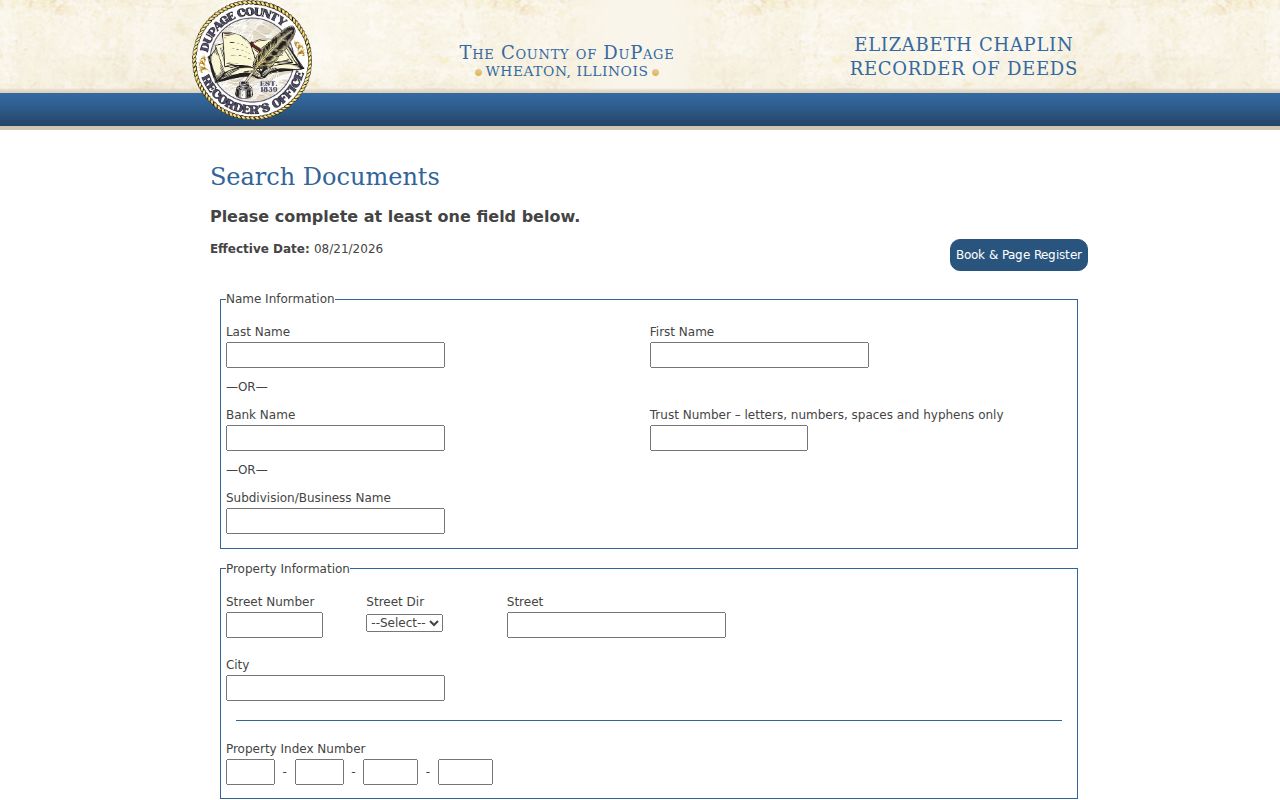
The form illustrates why a PIN or document number is more exact than a broad city-and-street query. For records beyond the computer cutoff, call the Recorder Research desk at 630-407-5401 or use the counter at 421 N. County Farm Road in Wheaton.
Read Villa Park Parcel Terms
County pages use a few short terms that carry a lot of weight. Read them before copying a name into street directory notes.
- Parcel
- A mapped piece of land identified by a county PIN. One postal address can change while the land record remains linked through parcel history.
- Situs address
- The location assigned to the property itself, distinct from the address used for tax mail.
- Plat
- A recorded map that lays out lots, blocks, streets, or a subdivision. It can bridge an old description to a current parcel.
- Criss-cross directory
- A directory arranged by address or phone rather than only by surname, useful for a dated look at who was listed there.
Legal descriptions are especially useful after a lot split, combination, or change in a street label. Match the lot, block, and subdivision to the recorded deed image. Never assume that a modern house number appears in the oldest instrument.
Villa Park Permits by Street
The Villa Park Permitting Division handles address-linked work such as fences, garages, driveways, electrical work, plumbing, roofing, pools, sheds, signs, decks, and additions. The current process supports electronic submission, status or correction tracking, payment, and downloads. A releasable application may contain the project address, description, value, permit number, applicant, owner, contractor, and status.
Those names describe roles in a project. A permit applicant may not own or occupy the property. For older records, or when no public case screen exists, make a bounded request through the Village department or its NextRequest FOIA route. State the exact address, date span, record type, and preferred electronic format. Ask for existing records and nonexempt portions rather than a newly compiled list of residents.
The successful capture assigned to this page comes from the official division: compare the current permit instructions with this saved view.
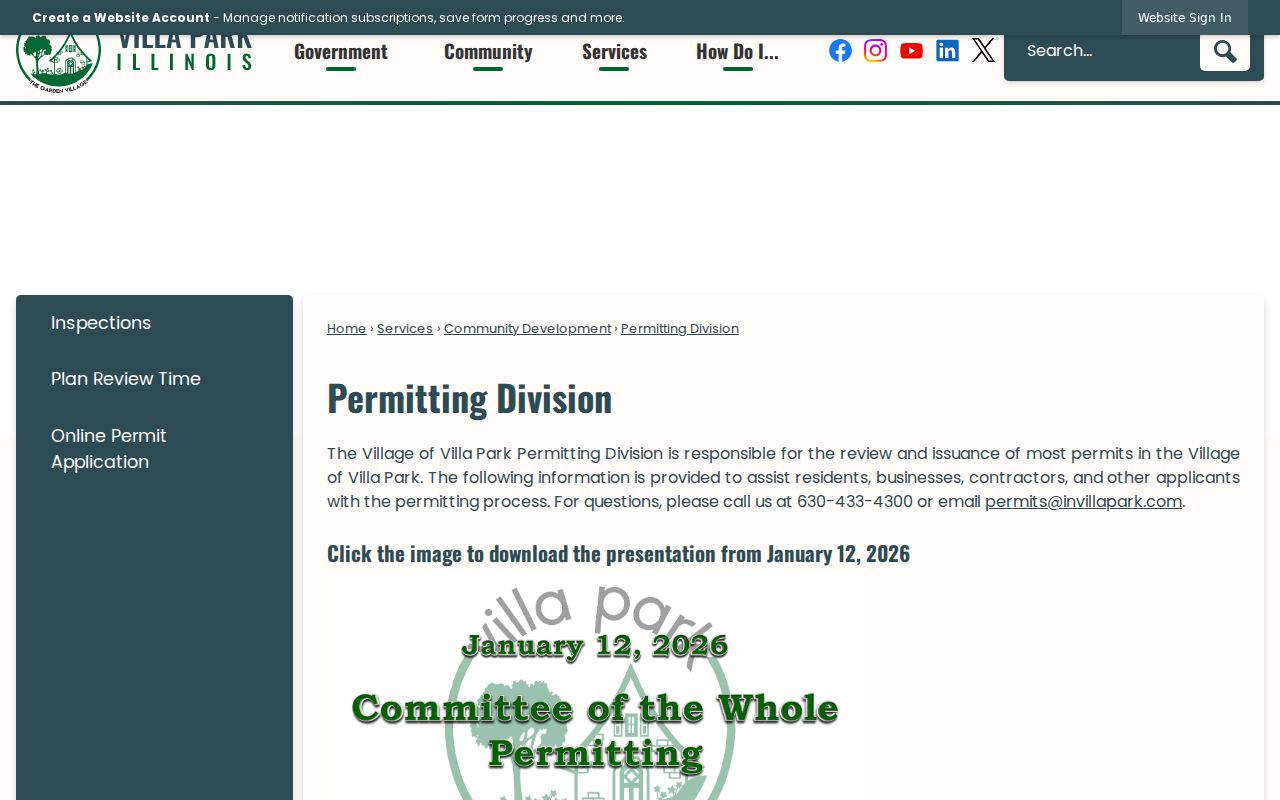
The page confirms the department route, while the record for a particular street still requires a precise address search or request. Property-maintenance complaints may also be address keyed, but no open index of individual cases was found.
Check Villa Park Voter Matches
The Illinois registration lookup begins with first name, last name, birth date, and a five-digit ZIP. A second stage confirms the street address. This is a match tool, not a way to browse everyone on a Villa Park road. The DuPage Election Division is the fallback for election records and for questions about the controlled full voter-file process.
Illinois registration cards are public within election-period and confidentiality limits, but the statewide data file is purpose controlled. Address Confidentiality Program participants can have protected address handling. A non-match may reflect input differences, timing, inactive status, or protection. It does not prove that the person is absent from the address.
Note: Use a voter result as one dated match and confirm it against an independent official record before sharing a name.
Historic Villa Park Street Clues
Villa Park grew from subdivisions platted in 1908 and Ardmore in 1910. The communities united under Ardmore in 1914 and took the Villa Park name in 1917. Old deeds, newspapers, and directory entries may therefore use a subdivision or place label that does not match a modern search box. A Recorder plat and legal description are the sound bridge.
The Villa Park Public Library local collection holds newspapers, yearbooks, government documents, and microfilm. The Historical Museum Resource Center has a few old directories and phone books, although exact volume years are not posted. The digital McDonough DuPage County directory covers 1925–26. Use the Villa Park city directory collection for the historical shelf, then return to the parcel chain for the current address.
No confirmed Villa Park street-renumbering year or dedicated local Sanborn run was found. Do not invent either. When the number fails, search by subdivision, lot, block, historic place name, or a nearby landmark such as the Great Western Depot or Ovaltine plant.
Villa Park Street Directory Limits
A street directory assembled from public records cannot name every resident. Assessment cards emphasize parcels and billing owners. Deeds name transaction parties. Permits name project roles. The voter site only tests supplied details, and protected records may not appear. Private utility customer lists and driver addresses are not public street rolls.
Commercial people-finder results can be stale, merged, or detached from the official source. Use the county and village custodians for a parcel, deed, permit, or election fact. If an online index stops, try the public counter, a phone inquiry, a narrow written request under the Illinois Freedom of Information Act, or the library and museum for older material.
Lawful use. Villa Park address records support family history, property research, civic review, and personal safety. Never use a name or address to stalk, harass, intimidate, or harm someone.
A cautious conclusion may be that no public source confirms the person at that address. That is more accurate than filling the gap with a guess.